
European organisations are turning to third-party energy experts to help navigate a path through the energy transition. Here in the UK, companies need to negotiate their way around current government policy and funding landscapes: to balance the agendas of sustainability and resilience, and to futureproof their business. In this blog, we look at the impact of grid capacity and battery storage as a means to manage these issues as we negotiate the energy transition.
Carbon targets: hit and miss?
The Clean Power 2030 Action Plan was always going to be ambitious, and Offshore Energy UK’s Offshore Wind Insight pinpoints several key recommendations to help get CP30 targets on track. Energy security is clearly going to be a long-term theme, even for a system that is significantly renewables-based. And national infrastructure is critical,
“Rebuilding the transmission grid will be a massive task. A grid investment program of £58bn will be required to support 50GW offshore wind by 2030.” [1]
Many businesses already admit they are likely to miss interim carbon targets on the 2050 net zero timeline, yet most continue to prioritise sustainability, whether to help meet regulatory requirements; stakeholder and customers’ reputational demands, or as part of overarching ESG policies.
Grid capacity issues in the midst of a drive to electrification impact net zero targets for many companies and can hamper investment plans. For energy management, sustainability goes hand-in-hand with the demand for resilient power and the need to mitigate financial risks in a volatile energy market. In a recent report, looking at energy trends, 44% of British / Irish businesses said that supplier or infrastructure limitations are a major hurdle.[2]
Grid capacity: A barrier to progress
The bottlenecks for UK companies looking to increase their own site capacity – to allow for EV charging, for example – are well-known. The National System Energy Operator (NESO) admits that the growth in grid connection applications outstrips the feasibility of delivering connection reforms in parallel with processing existing applications. As at the beginning of January 2025, there were 1,700 connection applications covering 2023/24, meaning “more projects already in the queue than are required for the energy system in 2030 or even 2050.” [3]
While energy network operators began to take evidence from customers in May, as part of Ofgem’s connections reform policy (TM04+), UK SMEs still face multiple hurdles and the potential for significant issues along the energy/electricity pipeline.
Taking control and managing uncertainty
With continued misgivings over the UK’s ability to achieve net zero policy targets with the required infrastructure to manage the demands of electrification, businesses are taking greater control of their own energy infrastructure, engaging third-party energy experts to advise on the best way to manage the transition. And 76% of businesses surveyed recently say they are likely to partner with third-party providers to enhance energy operations over the next year[4]. Companies continue investment, or plan to invest in, energy infrastructure:
- 28% trialling or planning to adopt solar panels on-site in the next two years, while 43% have already adopted solar PV;
- 33% of businesses trialling or planning to adopt battery storage units in the next two years, while 38% have already adopted battery storage[5].
There is clear evidence that sustainability and clean power benefits the UK economy, and the CBI estimates that every £1 value generated by the net zero economy creates an additional £1.89 value across the wider economy[6]. Though interim UK targets may be hard to achieve, the end goal is still net zero. But businesses are concerned about the financial risks associated with investing in their own emission reduction strategies.
To mitigate risk, partnering with a trusted energy technology management specialist can be an effective way for a business to expedite stakeholder buy-in and attract investment, while helping to ensure optimum asset purchase or infrastructure upgrade to manage on-site energy demands.
Solving electrification challenges with the right energy management technologies

For organisations seeking a major energy infrastructure solution, a smart microgrid enables a site to operate off-grid, helping to avoid issues of power resilience and enabling them to take significant control over their power supply. But implementing a microgrid can represent a major investment for many SMEs, and could be a stage further down the net zero journey, a path that builds on and incorporates existing standalone or connected assets.
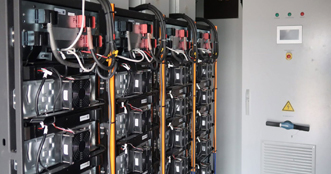
Investing in energy management technologies can inform these incremental steps towards electrification and decarbonisation: building a range of assets, each of which can lower emissions and help shore-up power resilience on-site. For example, a Battery Energy Storage System (BESS), when incorporated with an Uninterruptible Power Supply (UPS), helps ensure power resilience. With up to 95% lower losses than traditional UPS, where there is disruption to grid supply Powerstar’s BESS with UPS responds within 10 milliseconds, ensuring equipment and operations are protected against fluctuations in grid power. Given the level of uptake in on-site renewables noted earlier, a BESS is the next logical investment to help maximise ROI, storing this sustainable and cost-effective energy as it is generated for use when needed, and it can further help reduce energy spend through the capability to store grid energy bought when purchase price is at its lowest, for use when prices are at their peak.
As grid connections continue to hamper businesses’ ability to decarbonise and to electrify operations, a BESS can allow for high-demand technologies such as EV charging by circumventing the need to rely solely on grid supply: the battery stores electricity as DC rather than AC, which can facilitate more rapid charging and, since the chargers are connected directly to the battery, the BESS operates as a buffer without impacting grid supply.
The average cost to a large business for an additional grid connection is estimated at around £65,000[7]. The financial impact is two-fold: this level of investment may be prohibitive for many companies, and it also raises the issue of longevity. Where a business leases its site, there may be the additional need to factor in the ROI on the sunk cost of additional grid connections. By comparison, a BESS offers both the short-term capabilities to help address grid constraints, and can prove a valuable and flexible asset in the longer term.
Working with a trusted UK energy expert
Exploring options with a UK-based manufacturer can help de-risk issues when looking for an energy management specialist. The key is to work with experts who can assess your site and energy needs; assist with relevant energy audits and feasibility studies prior to any asset specification, and then make recommendations – with transparent data on benefits and ROI, such as reduced energy usage, and more resilient power supply.
In the lead up to CP30, leveraging energy management technologies can be advantageous for business stability and growth – taking control of your own energy infrastructure when grid constraints present ongoing issues for UK energy policy. Whether investing in on-site renewables or looking to shore-up your power resilience, BESS can be a valuable asset. And working with an energy management specialist whose innovation is firmly driven by customer needs can help protect your energy infrastructure investment, and indicate where further improvements can be made: for power resilience; for improved sustainability, and for lower energy spend.
[1] https://oeuk.org.uk/record-increase-in-offshore-wind-capacity-critical-to-clean-power-2030-goal-says-oeuk-report/
[2] https://www.centricabusinesssolutions.com/navigating-energy-labyrinth-lp?utm_source=cbs_email&utm_medium=email&utm_campaign=0001447+-+UKI_2025_Resilience_FullReport&utm_id=0001447+-+UKI_2025_Resilience_FullReport
[3] https://www.neso.energy/news/next-steps-grid-connections-reform
[4] ibid. p.18
[5] ibid. p.24
[6] https://eciu.net/analysis/reports/2025/net-zero-economy-across-the-uk